Import rules · updated 27 October 2026
Sugar import rules by country: duty and permits for Brazilian white sugar.
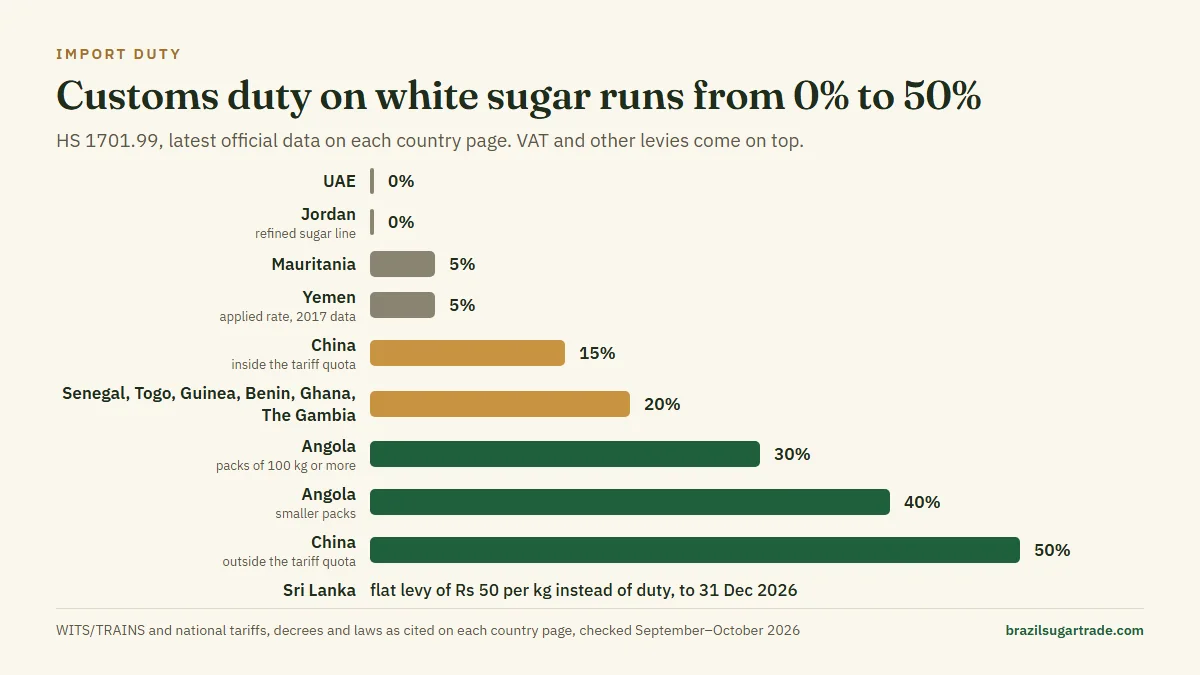
Customs duty on white sugar runs from 0% in the UAE and Jordan (refined) to 20% in most of West Africa and 30% to 40% in Angola depending on pack size, with Mauritania at 5%, Sri Lanka charging a flat levy instead, and China charging 50% outside its tariff quota. Brazil’s largest white sugar destinations in 2025 were in West Africa: Mauritania, Senegal, Togo, Guinea, Angola, Ghana and The Gambia, plus Sri Lanka. Most are open to a private importer with the right permits; Senegal is closing from November 2026, and Ghana, The Gambia and Angola attach conditions. The table gives each country’s verdict, duty and key permit, with a full page behind each one. Côte d’Ivoire, Kenya, Tanzania, Vietnam and Cameroon are closed or close to closed for Brazilian white sugar, explained below.
| Country | Can a private importer bring in white sugar? | Customs duty (latest data) | Key permit |
|---|---|---|---|
| Mauritania | Open (latest official review 2018) | 5% (2023) | No sugar-specific licence found |
| Senegal | Closing: imports to stop from November 2026 (announced) | 20% (2023) | DIPA; imports opened and closed by the ministry |
| Togo | Open | 20% (2023) | Destination inspection certificate |
| Guinea | Open; sugar on the essential-goods list | 20% (2023) | Import declaration (DDI) |
| Angola | Conditional, tightening | 30% big bags, 40% smaller packs (2026) | Import licence; 20% local purchase (June 2026) |
| Ghana | Conditional: FDA and GSA permits | 20% (2023) | FDA importer licence + e-permit; GSA registration |
| Sri Lanka | Open | Rs 50/kg levy, replaces other taxes | SLS 191 inspection; Food Act approval |
| The Gambia | Conditional: essential-commodity licence | 20% (2023) | Minister of Trade licence; FSQA registration |
| The UAE | Open | 0% | Trade licence; ZAD / FIRS product registration |
| Jordan | Open | 0% on refined (1701.99.10) | Importer card; JFDA clearance |
| Benin | Open by sea, through Cotonou | 20% (2023) | Benin Control certificate (AVD); single-window declaration |
| Yemen | Conditional: port control and payment decide | 5% (2017) | UN inspection (UNVIM) for Hodeidah, Saleef and Ras Isa; bank clearance |
| China | Conditional: quota for refiners; 50% outside it | 15% in quota / 50% outside | Quota or automatic import licence; GACC-registered producer |
Your country is on the list? Send your grade, quantity and discharge port.
Send a requirement →Countries without a page, and why
These markets are closed or close to closed for a private importer of Brazilian white sugar. A page telling you how to import would be misleading, so here is the short version.
- Côte d’Ivoire. An interministerial order of 4 June 2010 temporarily suspended sugar imports, and when imports are allowed, only the two local producers may bring sugar in (WTO, 2017). The US Commerce Department still listed sugar as a prohibited import in May 2026, citing a 2008 decree. The latest agreement between the state and the producers ran to 31 December 2025, and the government said it planned to renew it; we found no 2026 decision. Brazil still shipped 213,025 tonnes of white sugar there in 2025. We could not confirm how much moved under the producers’ import permits and how much was in transit to Mali and Burkina Faso. Without an import authorisation, sugar is a prohibited import.
- Kenya. Sugar from outside the COMESA and EAC blocs, Brazil included, pays the EAC common tariff of 100% or 460 US dollars per tonne, whichever is higher. Registered industrial users can import at 10% inside government-gazetted windows, with Kenya Sugar Board licences and a pre-import permit (USDA, Kenya Sugar Annual, April 2026; EAC Gazette, June 2026).
- Tanzania. Since July 2024 only the National Food Reserve Agency may import sugar to cover the domestic shortfall (Finance Act 2024). Registered industrial users can import refined sugar at 10%.
- Vietnam. Refined sugar outside the tariff quota paid 85% in the latest tariff data (2023). The quota is auctioned by the Ministry of Industry and Trade, and refined-sugar quota goes to manufacturers who use the sugar themselves.
- Cameroon. Sugar imports need government authorisation within CEMAC’s common sugar regime (WTO, 2023), and for the 2025–26 season the state daily Cameroon Tribune reported the commerce ministry’s position that new imports were not justified.
- Iraq and Qatar. Iraq requires a COSQC certificate of conformity for every shipment, but we could not confirm the current duty on sugar. Qatar is open at 0% duty with importer and product registration in the Ministry of Public Health’s Watheq system, but Brazil shipped almost no sugar there in 2025.
Every country page lists its sources and the date of each figure. Tariffs move by decree, so confirm with customs before you order.
Sources
- ComexStat (MDIC), Brazilian exports by NCM 1701.99.00 and 1701.14.00, January–December 2025, via api-comexstat.mdic.gov.br, retrieved 29 Sep 2026
- Sources for each country are listed on its page.
- USDA FAS GAIN, Kenya Sugar Annual KE2026-0009, 6 Apr 2026; EAC Gazette Vol. AT1 No. 16, 30 Jun 2026
- Tanzania Finance Act 2024, s.86: https://www.tra.go.tz/images/uploads/acts/Finance_Act_2024_(1).pdf
- World Bank WITS / UNCTAD TRAINS, MFN tariff for HS 170199, Vietnam, 2023; Ministry of Industry and Trade, tariff quota decisions, 15 Sep 2025: https://moit.gov.vn/
- WTO, Trade Policy Review: CEMAC, WT/TPR/G/445, 2023; Cameroon Tribune, 17 Nov 2025
- WTO, Trade Policy Review: WAEMU, WT/TPR/S/362, 2017, Annex on Côte d'Ivoire, para 4.34: https://www.wto.org/french/tratop_f/tpr_f/s362-03_f.pdf; US International Trade Administration, Côte d'Ivoire Country Commercial Guide, prohibited and restricted imports, 26 May 2026: https://www.trade.gov/country-commercial-guides/cote-divoire-prohibited-and-restricted-imports; KOACI, 28 Oct 2025: https://www.koaci.com/article/2025/10/28/cote-divoire/societe/cote-divoire-la-sucaf-ci-plaide-pour-le-renouvellement-de-son-contrat-avec-le-gouvernement_191549.html
- TÜV Rheinland, Iraq ICIGI programme update, 1 Jun 2025; Qatar Ministry of Public Health / Hukoomi, food product registration, 29 Jan 2025
Checked on 27 October 2026. Rules and web pages change; check the source before you rely on a detail.